
Meal Delivery vs Meal Prep vs Private Chef: The Real Cost
The short answer
Meal delivery apps carry the highest true cost per meal and give you no control over oils, sourcing or protein grade. Traditional meal prep services are cheaper but are engineered for shelf life, shipping and margin rather than for your body. A private chef gives you real quality and control, but it is a hire: you manage a person, a schedule and a grocery budget, and you pay travel costs when you travel. Elevated Eats was built as a fourth option, a fully managed performance nutrition system where nutritionists design your menu, trained performance chefs cook it, and it arrives at your door across 50+ cities with nothing for you to supervise.
The cost nobody puts on the invoice
Most people evaluate their food options on one number: price per meal. It is the easiest number to find and the least useful one to optimize.
The cost that actually matters does not appear on any receipt. It shows up as the afternoon crash that eats your best two working hours. It shows up as the recovery that takes an extra day, the digestion that quietly runs poorly for months, the sleep that never gets deep enough, the focus that arrives late and leaves early. Over a season or a fiscal year, those add up to a meaningful amount of output.
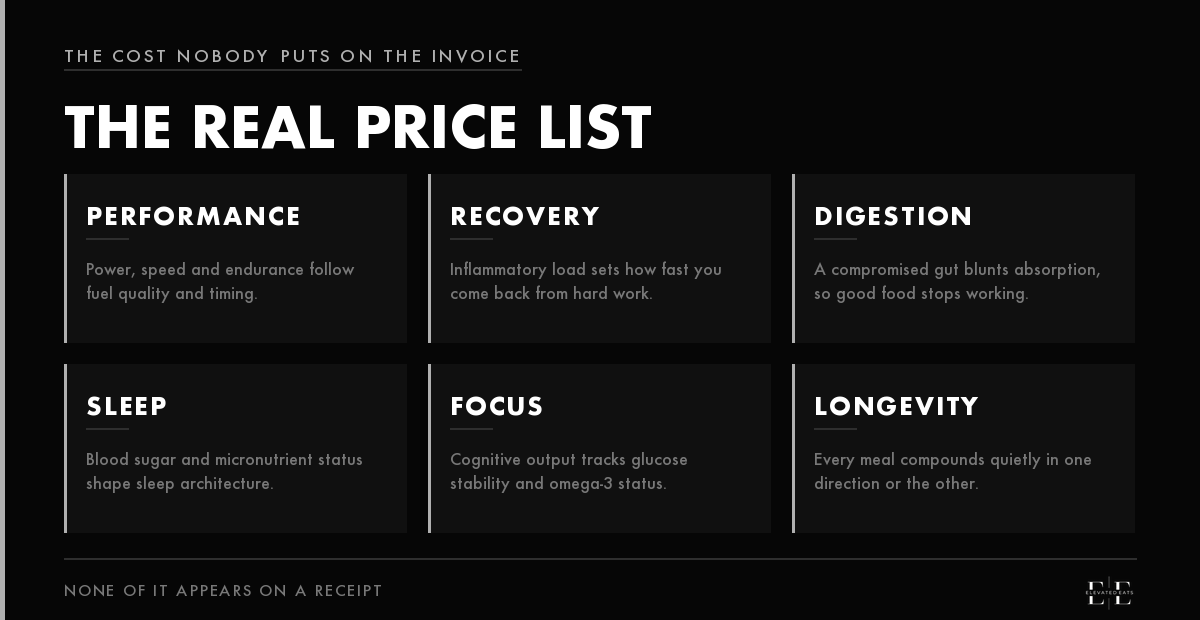
That is the real price list:
- Performance. Power, speed and endurance are downstream of fuel quality and timing.
- Recovery. Inflammatory load determines how fast you come back from hard work.
- Digestion. A compromised gut blunts absorption, so good food stops working.
- Sleep. Blood sugar and micronutrient status shape sleep architecture directly.
- Focus. Cognitive output tracks glucose stability and omega-3 status.
- Longevity. The cumulative effect of every meal, compounding quietly in one direction or the other.
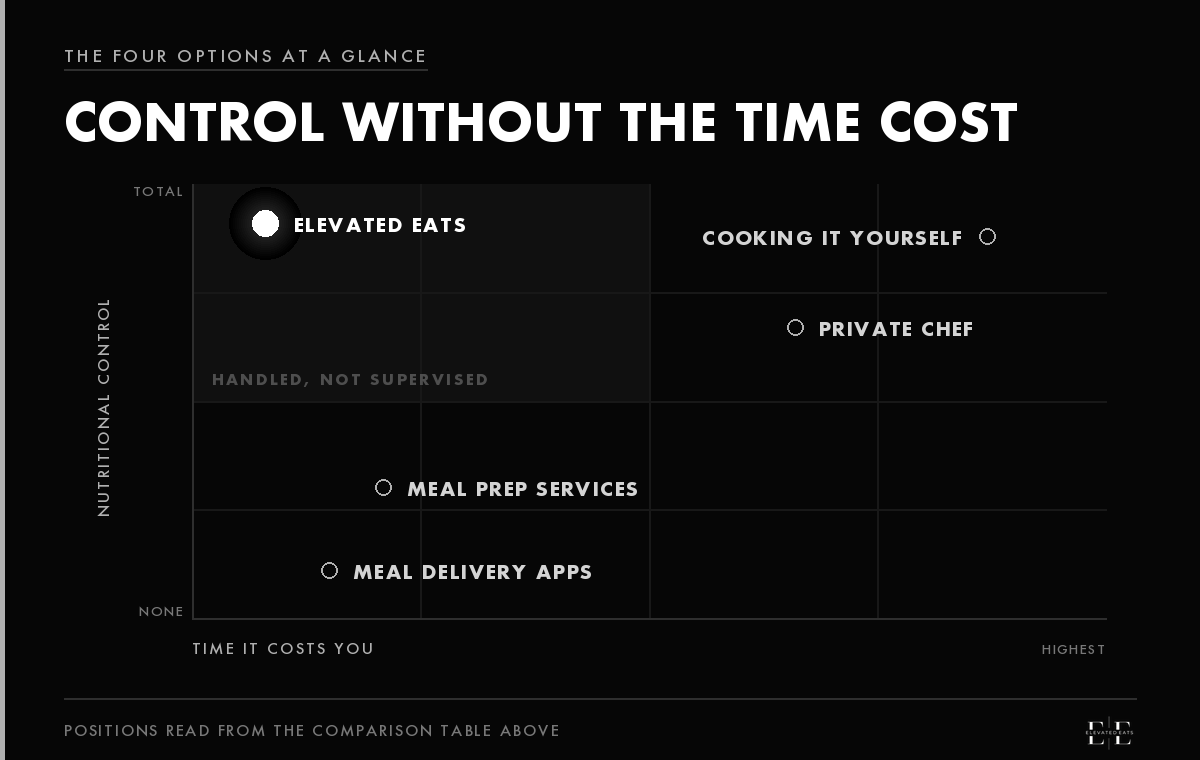
Most food options on the market are short term solutions. They are built for convenience, shelf life and mass production, which are the manufacturer's goals, not yours. Here is how the four common options actually compare, and where Elevated Eats fits.
The four options at a glance
| Option | What you actually pay for | Nutritional control | Time it costs you | Best fit |
|---|---|---|---|---|
| Meal delivery apps | Marked up menu price, service fee, delivery fee, tip | None. No visibility into oils, sourcing or protein grade | Low to order, high to correct later | Occasional convenience, not a nutrition strategy |
| Traditional meal prep services | A subscription priced for mass production | Low. Menus are built for shelf life, shipping and margin | Low | General healthy eating on a budget |
| Private chef | Salary or day rate, groceries, payroll and insurance if employed, travel costs on the road | High, but only as deep as one chef's nutrition knowledge | High. Scheduling, menu revisions, kitchen access, managing a person | Households that want a person in the home and will manage them |
| Cooking it yourself | Groceries, plus your own hours | Total, if you have the knowledge and the discipline | Highest. Planning, shopping, cooking, cleaning, every week | People whose time is not their scarcest asset |
| Elevated Eats | One managed program fee, delivered | Total. Designed per person by nutritionists, cooked to spec | Near zero. The plan, cooking, delivery and weekly adjustments are managed | Athletes and high performers who need nutrition handled, not supervised |
Scroll the table sideways on mobile to see every column.
Option 1: Meal delivery apps
Delivery apps feel like the convenient choice until you look closely at both halves of the bill.
What you actually pay
The menu price on a delivery app is typically marked up above the price the restaurant charges in house. On top of that sits a service fee, a delivery fee and a tip. The number you pay per meal lands well above the number you thought you were agreeing to, and it lands there every single time.
What you cannot see
The larger problem is visibility. When a restaurant cooks your meal, you do not know which oil it was cooked in, what grade the protein was, where the produce came from, or how much sodium and sugar went in. Restaurant kitchens optimize for flavor and food cost, which is a reasonable thing for a restaurant to do and a poor foundation for a performance plan.
Without that visibility you cannot run the loop that makes nutrition useful: eat, measure how you performed, adjust. Fast is only convenient if the meal is not quietly working against your energy, focus, recovery and digestion.
Option 2: Traditional meal prep services
Traditional meal prep services are a genuine step up from delivery apps. Portions are controlled, macros are listed, and the food arrives without a decision attached. For plenty of people, that is a real improvement.
The limitation is structural rather than a failure of effort. Most meal prep companies sound built for health, and they are built for scale. Those are different design goals, and scale wins every time it conflicts with individualization:
- Mass produced menus. The same rotation goes to thousands of customers regardless of body composition, sport or training load.
- Cooked well in advance. Recipes are chosen for how they survive a week of shipping and refrigeration.
- Built for shelf life and margin. Ingredient decisions follow food cost and stability, which is why seed oils are common.
- Generic portions. A size small, medium or large is not a macro target built around your week.
- Minimal customization. You choose from a menu, rather than the menu being built around you.
A menu designed for the average of thousands of people is, by construction, designed for nobody in particular. If your goals are general, that is fine. If your goals are specific, the gap between the plan and your physiology is the part that costs you.
Option 3: Hiring a private chef
A private chef is the option most people reach for once they can afford to stop compromising, and it solves real problems. The food is fresh, it is made to your taste, and a good chef will happily work to a nutrition brief.
What is easy to underestimate is that hiring a private chef is a hire. It brings a person into your home, your schedule and your daily life, and it brings the management that comes with any staff:
- Cost structure, not just a rate. A salary or day rate, plus groceries, plus payroll taxes and insurance if the chef is employed rather than contracted.
- Coordination. Schedules to align, kitchen access to arrange, menu revisions to review, holidays and sick days to cover.
- Travel economics. A private chef can absolutely travel with you. You pay the flights, the hotels and the days away, which is why most clients quietly go back to eating whatever is available on the road.
- Single point of knowledge. You get one chef's nutritional understanding. Most chefs are trained to optimize for flavor, not for recovery, inflammation, sleep architecture or long term health.
- Continuity risk. When the chef leaves, the system leaves with them.
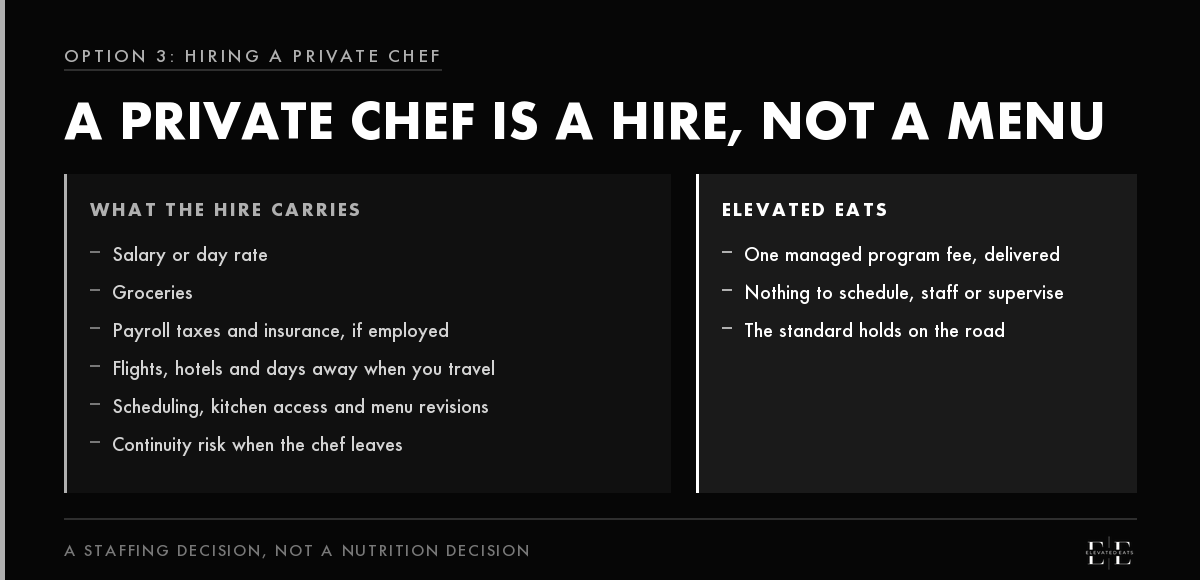
None of that makes a private chef the wrong answer. It makes a private chef a staffing decision rather than a nutrition decision. For a lot of high performers, what starts as a way to simplify life becomes one more expensive thing to manage.
Option 4: Cooking it yourself
Cooking your own food gives you total control over every ingredient, and it is the cheapest option on a pure cash basis. If you have the nutritional knowledge and the time, it is a legitimately good answer.
The cost is your hours, and they are not small ones. Planning a week of meals against a training block, shopping for it, prepping, cooking and cleaning is a recurring commitment that lands in the same evenings you needed for recovery, family or work. It also has to survive travel weeks, heavy training blocks and the weeks when everything else goes wrong, which is precisely when nutrition matters most and when self-managed systems tend to break.
The honest test: if your time is your scarcest asset, cooking your own food is the most expensive option on this list.
Limited intake by city
Elevated Eats holds capacity per city, and every menu is designed from scratch, so plan on a 2 to 3 week lead time.
Your place in your city is held the day you commit.
Why Elevated Eats was built
Elevated Eats exists because there was a gap between the option that was convenient and the option that was actually good for you, and nobody was filling it.
Elevated Eats is performance fuel for athletes, high performers and founders who value their time and their health enough to stop treating nutrition as the last unaddressed variable. Everything is customized to the individual: your goals, your schedule, your training load, your recovery demands, your family and your longevity. It arrives at your door.
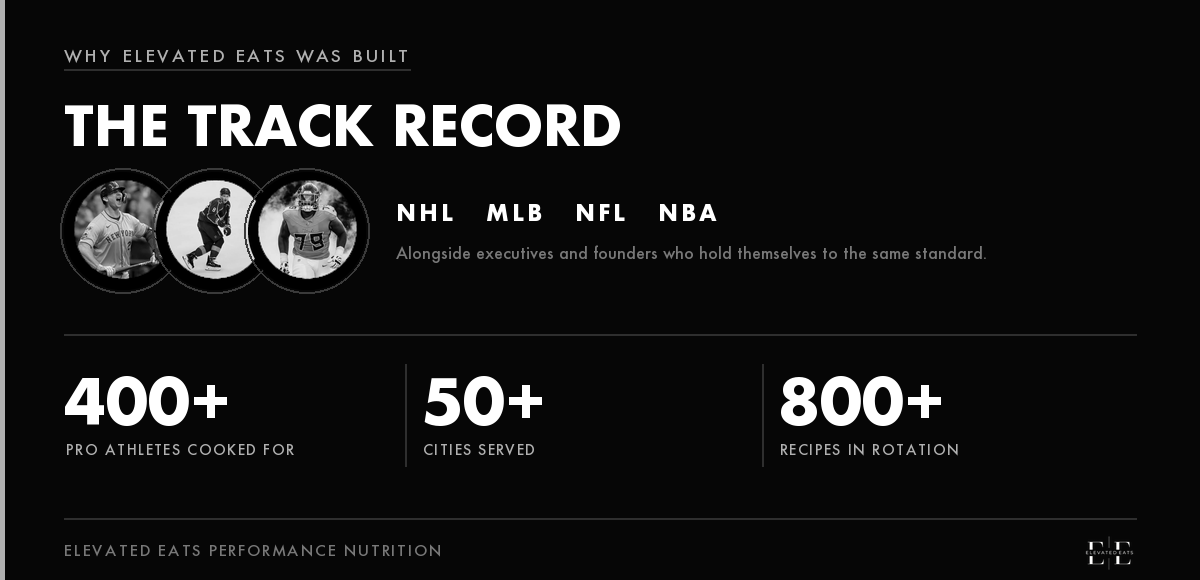
Elevated Eats has cooked for 400+ professional athletes across the NHL, MLB, NFL and NBA, alongside executives and founders who hold themselves to the same standard.
The Elevated Eats ingredient standard
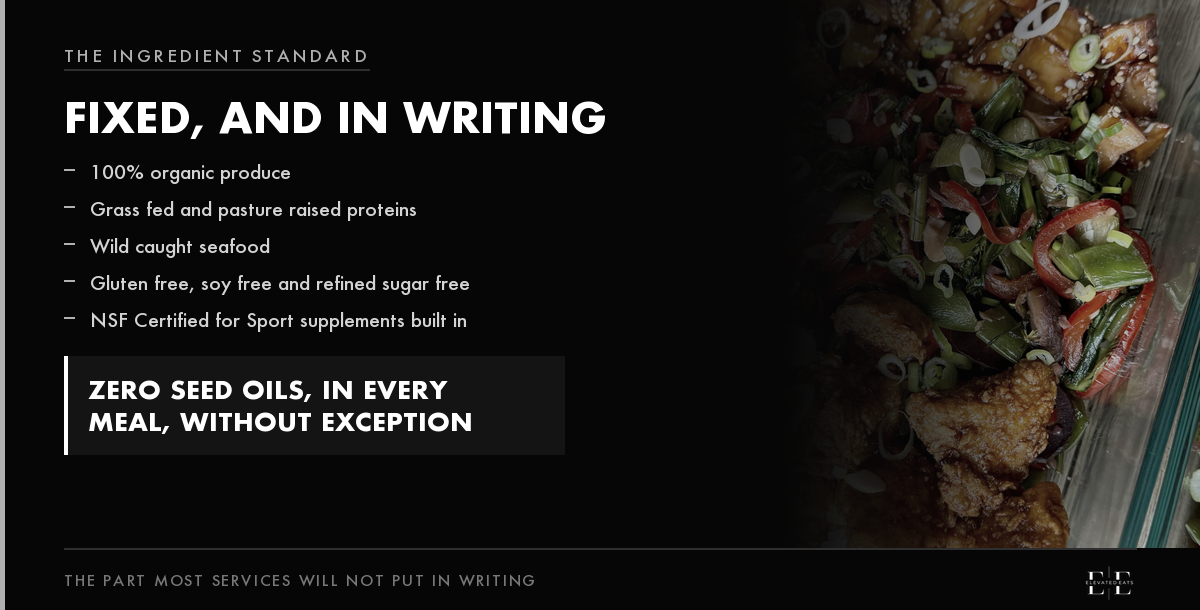
The standard is fixed, and it is the part most services will not commit to in writing:
- 100% organic produce
- Grass fed and pasture raised proteins
- Wild caught seafood
- Gluten free, soy free and refined sugar free
- Zero seed oils, in every meal, without exception
- NSF Certified for Sport supplements, adaptogens and nootropics built into the meals and snacks
That last point matters more than it sounds. Supplementation built into the food is supplementation you actually take, on schedule, without another routine to maintain.
What a menu actually looks like
Performance food has a reputation for tasting like a compromise. Elevated Eats is known for the opposite: upgrading childhood favorites on purpose, so the comfort food genuinely supports the body. A menu might include:
- Grain free beef lasagna
- Beef taquitos with avocado crema
- Chocolate recovery donuts with cookie dough collagen frosting
- Strawberry shortcake protein jars
- Cookie dough recovery protein ice cream
- Slow cooked chicken curry with bone broth rice
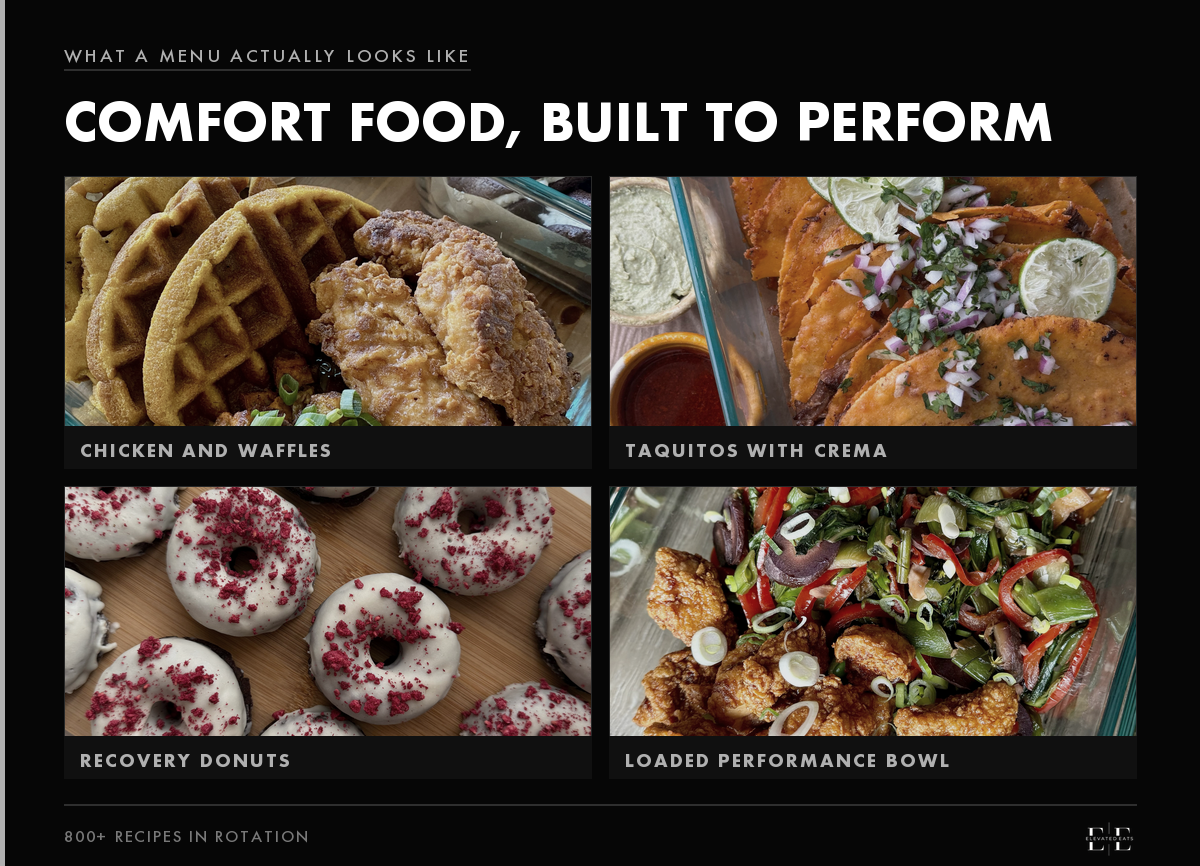
The rotation runs to 800+ recipes, which is the reason clients stay on the system long term. A nutrition plan only works if you actually want to eat it in month nine.
How the Elevated Eats system runs
The difference between Elevated Eats and a very good chef is what sits behind the cooking. Four functions run in the background so that none of them run in your calendar:
- Elevated Eats nutritionists build your menu around your body composition, training load, position, goals and recovery demands.
- Trained performance chefs execute it to spec, so what was designed is what you actually eat.
- Elevated Eats manages your schedule, travel and delivery timing across 50+ cities, so the standard holds on the road.
- A client success team reviews you weekly and adjusts the plan as your body responds and your season changes.
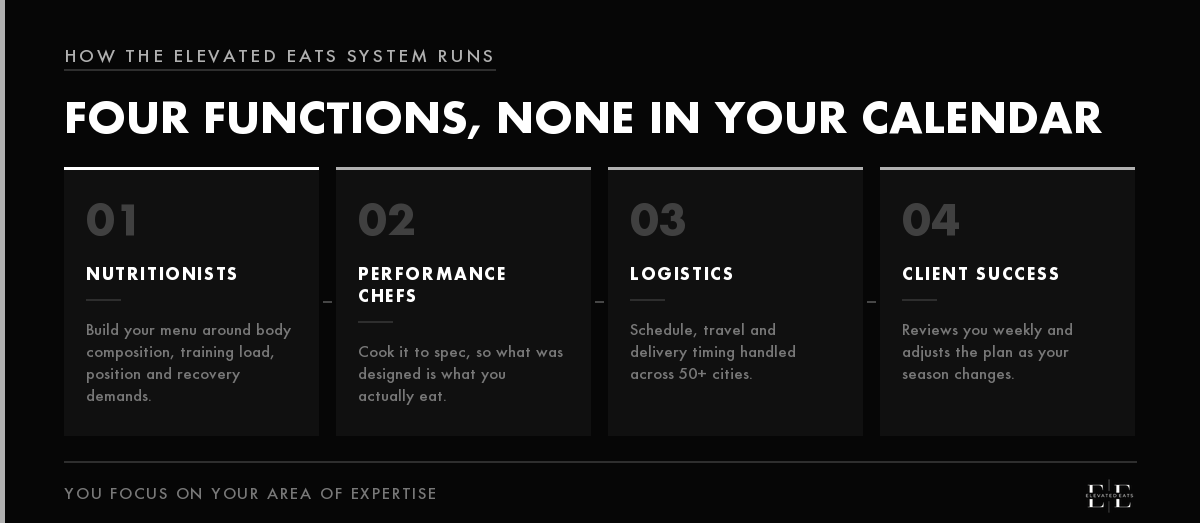
You focus on your area of expertise. Elevated Eats handles the rest.
What clients report
- More power and sustained output
- Better sleep quality
- Faster recovery between sessions and games
- Dialed in focus through the full working day
- Nervous system relaxation under a heavy load
- Caffeine free energy, with no afternoon crash to manage
“I really believe that what you put into your body is what comes out of your mouth and how you present yourself to the world.”
Jed Richard, CEO and Army veteran, Elevated Eats client
How to choose between the four
A straightforward way to decide, based on which constraint is actually binding for you:
- If cash is your tightest constraint and you have both the time and the nutritional knowledge, cook it yourself. It is the highest control option available.
- If you want to eat generally healthier without much thought and your goals are not highly specific, a traditional meal prep service is a reasonable fit.
- If you want a person in your home, enjoy shaping menus directly, and are willing to manage an employee and a grocery budget, hire a private chef.
- If your performance is the product and your time is your scarcest asset, you need nutrition handled rather than supervised. That is what Elevated Eats was built for.
Delivery apps are worth keeping for what they are genuinely good at, which is the occasional meal you did not plan. They are not a nutrition strategy, and nothing about the pricing suggests they were designed to be one.
Frequently asked questions
Is a meal delivery app cheaper than a performance meal service?
Rarely, once you total it honestly. A delivery app order carries a marked up menu price, a service fee, a delivery fee and a tip, and the per meal number lands far above the menu price you saw. The larger cost is that you have no visibility into the oils, the grade of the protein or the sourcing, so you cannot connect what you ate to how you performed.
What is the difference between Elevated Eats and a traditional meal prep service?
Traditional meal prep services optimize for scale: mass produced menus, long shelf life, generic portions and minimal customization. Elevated Eats builds each menu around one person. Elevated Eats nutritionists design the plan around your body composition, training load, travel schedule and goals, trained performance chefs cook it, and a client success team adjusts it weekly.
Is Elevated Eats cheaper than hiring a private chef?
The comparison is not only the rate. A private chef is a hire: you pay a salary or day rate, you cover groceries, and if the chef is employed you carry payroll and insurance. You also manage the schedule, the menu revisions and the kitchen access, and when you travel you pay flights, hotels and days away. Elevated Eats removes the management entirely for a single program fee, and the food travels with you at no added staffing cost.
Can a private chef do what Elevated Eats does?
A private chef can absolutely cook excellent food, and many will work to a nutrition brief. The difference is what sits behind the chef. Elevated Eats pairs the cooking with nutritionists who design the plan, an 800+ recipe library, NSF Certified for Sport supplementation built into the meals, and weekly review. One chef is one person's knowledge. Elevated Eats is a system.
Who is Elevated Eats actually for?
Professional athletes across the NHL, MLB, NFL and NBA, plus executives, founders and high performers who hold themselves to the same physical and cognitive standard. Elevated Eats has cooked for 400+ athletes across 50+ cities.
What are the ingredient standards?
100% organic produce, grass fed and pasture raised proteins, wild caught seafood, gluten free, soy free and refined sugar free, with zero seed oils in any meal. Meals and snacks are infused with NSF Certified for Sport supplements, adaptogens and nootropics.
Do the meals travel?
Yes. Elevated Eats delivers across 50+ cities and builds travel into the plan, so the standard holds on the road as well as at home. Packaging is designed for planes, hotels and boardrooms.
How long does it take to get started?
Plan on a 2 to 3 week lead time from the consultation to the first delivery, because each menu is designed from scratch. Capacity is held per city, so your place in your city is reserved the day you commit.
If you are ready for food that matches the level you operate at, Elevated Eats reviews every application individually. Apply to work with Elevated Eats.
Keep reading
- How CEO and Army veteran Jed Richard fuels leadership at full capacity
- How NFL lineman Lloyd Cushenberry cut 7% body fat and got deeper sleep
- How MLB pitcher Garrett Whitlock juggles games, travel, training and a young family
- The athlete's secret weapon: how beets boost blood flow, endurance and recovery
- The 18 hour window: how NHL center Charlie Coyle recovers between games

Performance nutrition by invitation
If your food does not match the level you operate at,
it is costing you something.
Elevated Eats accepts a limited number of new clients per city.
Every application is reviewed individually. Elevated Eats only takes clients it can genuinely serve.
Apply to work with Elevated Eats →NHL · MLB · NFL · NBA · FOUNDERS · EXECUTIVES
More from the Elevated Eats blog
- The dangers of cheap food
- How beets boost blood flow, endurance and recovery
- Pete Alonso: holding every percentage of muscle across a 162-game season
- Matt Chapman: the best September of his career
- Garrett Whitlock: a full 162 with zero days on the IL
- Lloyd Cushenberry: 7% body fat down after an Achilles tear
- Charlie Coyle: winding down and recovering after late games
- Filip Forsberg: the first conscious step, every single day
- Spencer Knight: steady, caffeine-free energy for an NHL goalie
- Clay Holmes: celiac-safe meals and sustained energy
- Cedric Mullins: energy and recovery while managing Crohn's disease
- Nick Ahmed: recovering from the daily micro trauma of baseball
- Dave Carle: sleep, work output and a three-time NCAA champion coach
- Taylor Chapman: personalized nutrition through pregnancy and postpartum
- Jed Richard: a West Point graduate and CEO on leading at full capacity
- Elevated Eats at the Sundance Film Festival